ESCA Care: Privacy-first Sensor for Dementia Care
A radar sensor for caring better for people with dementia without invading their privacy: lifestyle monitoring that learns their patterns, warns of deviations and helps them live at home for longer, with no cameras and no images sent anywhere.
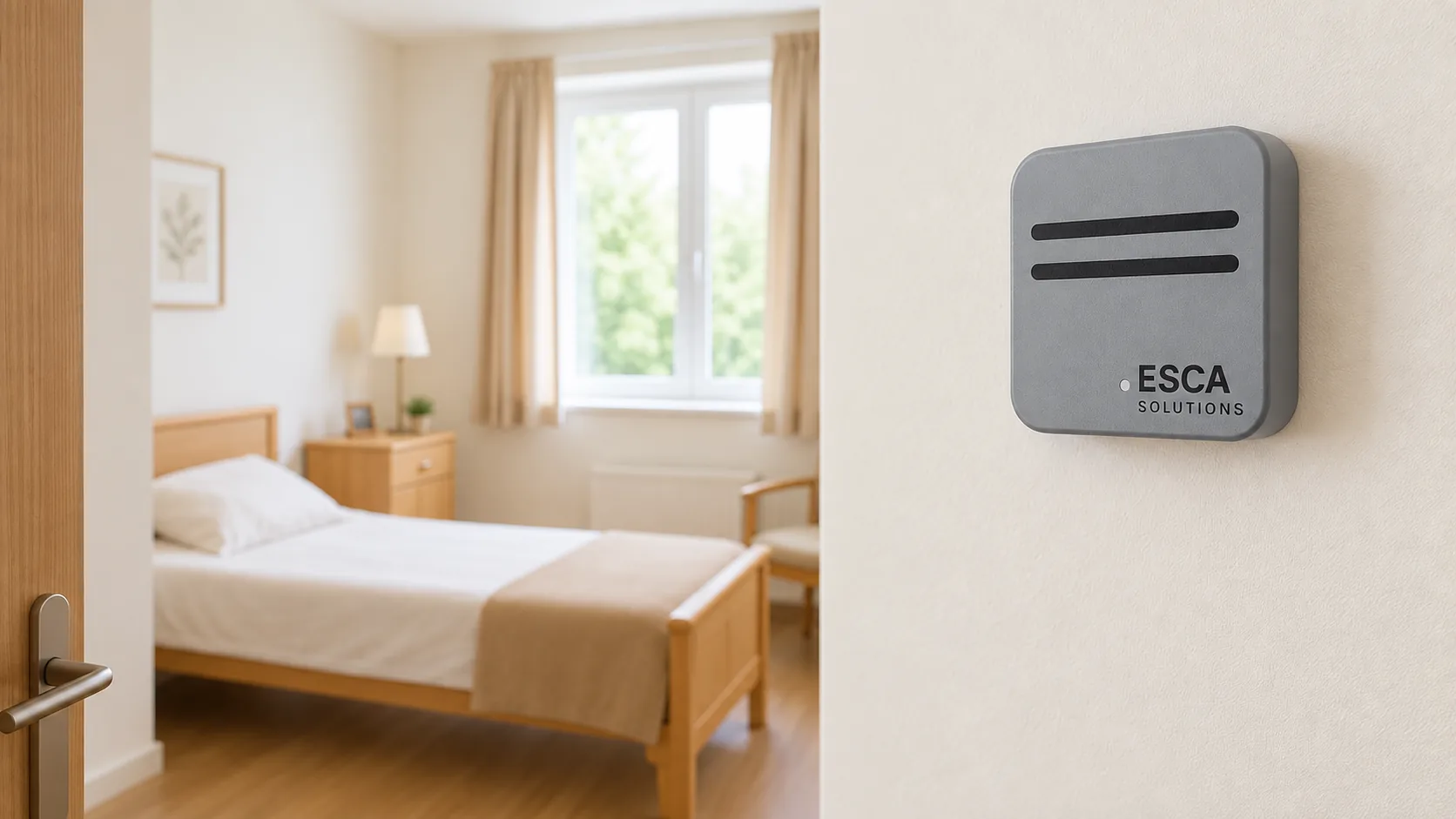
Overview
ESCA Care is our own sensor product, designed to care better for people with dementia without invading their privacy. It provides lifestyle monitoring: a radar-based device that tracks where a person is inside a room in 3D, with a range of roughly five metres and centimetre-level positional accuracy, records the person's patterns over time and flags deviations from them.
Challenge
People with dementia are often able to stay in their own home for longer if someone can keep an eye on how they are doing. Cameras solve that technically but invade the privacy of the person, in exactly the rooms where it matters most: bedroom, bathroom, living room. Simple motion detectors avoid the privacy issue but cannot tell where a person is, whether anyone is still present once movement stops, or what their usual routine looks like. Caregivers end up either visiting more often than needed or finding out too late.
Solution
We developed the sensor end to end: radar front end, custom electronics, embedded firmware the processing that turns raw reflections into tracked 3D positions, and the analysis that records the person's patterns and notices when they change. No camera and no image ever exists, so the privacy question disappears by design rather than by policy. The device reports over standard interfaces, so the information can reach caregivers remotely and show what is happening at home without anyone having to be there.
Outcome
The result is lifestyle monitoring that respects the person being cared for. It helps people live in their own home for longer, lets caregivers be present at the moments when they are needed, and gives them remote information about what is going on. It does more than detect presence: it records the patterns of the person and warns of deviations, in situations where a camera would never be accepted.
Related Projects
Pick & Place Robot Cell
Compact ABB robot integration for small-part handling. Custom gripper tooling, PLC coordination, and safety-rated cell design.
Pallet Object Scanning System
3D scanning and positioning system for palletised goods. Point cloud processing for quality control and logistics automation.
Industrial HMI Control Panel
HMI design for a multi-axis production system. Custom interface, alarm management and live process visualisation.
ESCA Level: Sub-millimetre Water Level Sensor
A water level sensor for open channels, measuring with sub-millimetre resolution and reporting remotely from the field.